
There is a particular moment at Hanging Gardens of Bali when you stop looking at the hotel.
It usually happens in the morning.
The air is still cool, the jungle is wet with overnight rain and the valley below is almost absurdly green. Somewhere down there, hidden beneath layers of vegetation, the Ayung River is moving through the gorge. There are birds in the trees. There is no traffic, no beach club soundtrack, no line of sun loungers stretching towards the horizon.
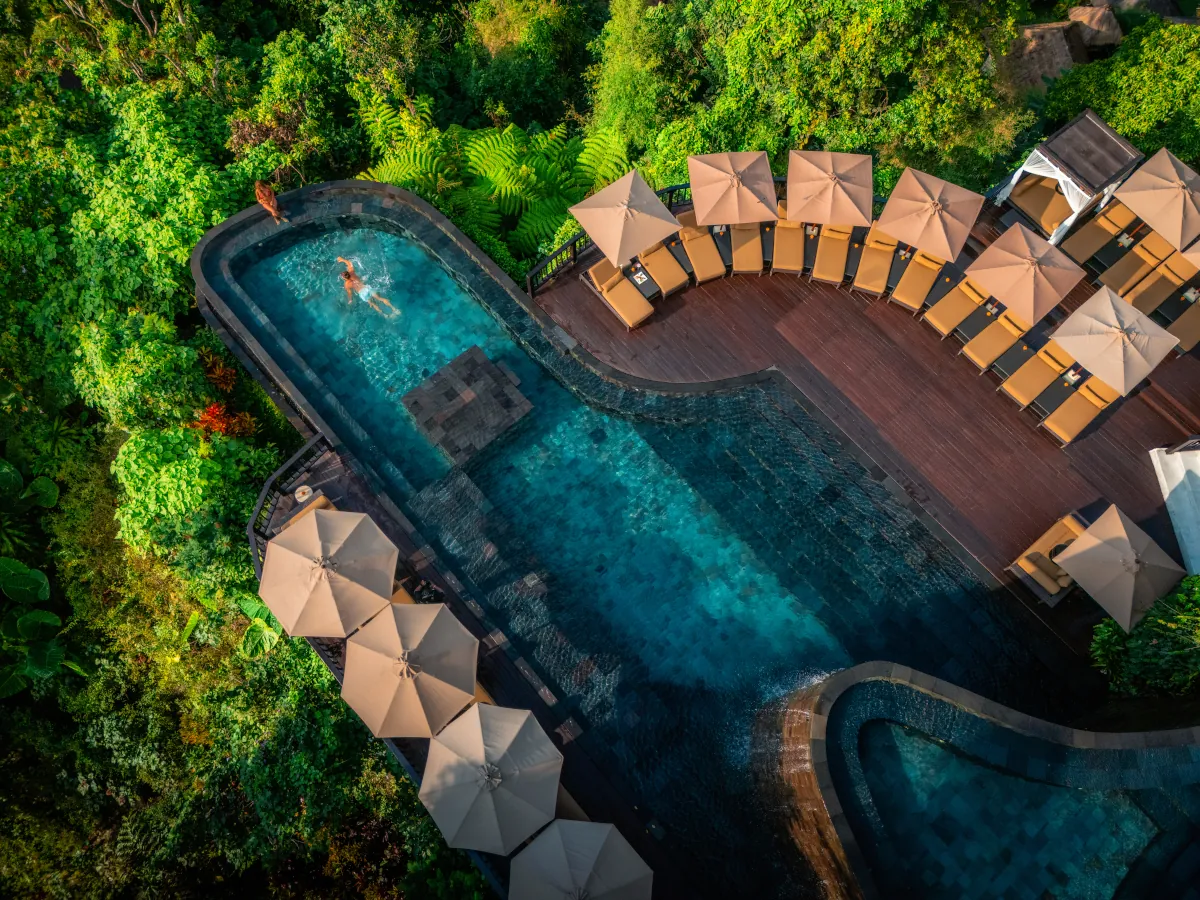
You are floating in a swimming pool.
And the swimming pool appears to be floating in the forest.
This is the trick Hanging Gardens has been performing since it opened in 2005. It takes one of Bali’s most dramatic natural settings and makes the architecture almost disappear.
Twenty years later, that still feels like a very good idea.
The hotel that made the pool famous
Hotels have become very good at making photographs.
Hanging Gardens was doing it before Instagram turned the infinity pool into a luxury-hotel requirement.
Its famous two-level pool, suspended above the Ayung River valley, became one of those rare hotel images that travelled far beyond the hotel itself. You could recognise it instantly: water at the edge of the rainforest, layers of jungle dropping away beneath it, and the impression that somebody had somehow built a swimming pool on the side of a mountain.
It is tempting to think of the pool as a piece of visual theatre.
But that undersells it.
The reason the design works is that it does not attempt to beat the landscape. It borrows its geometry.
The two pools echo the stepped terraces found throughout Bali, while the dark green forest provides the enormous backdrop. The result feels less like a swimming pool overlooking nature than a piece of Bali’s landscape that happens to contain water.
And there is something else worth remembering when judging a hotel by photographs: some hotels look better in pictures.
Hanging Gardens is better in person.
The valley has movement. Clouds come and go. Morning mist rises through the trees. Rain changes the colour of the forest. Sunlight appears, disappears and reappears somewhere else.
A photograph freezes all of that.
The real view doesn’t.
Forget the word “room”
Hanging Gardens has 39 villas and suites, including its various Pool Villa categories, Riverside Pool Villas, Panoramic Pool Villas and larger two-bedroom accommodation.
But “room” is not really the right mental model here.
The private pool is part of the architecture. The jungle is part of the room. The silence is part of the room.
This matters because the resort’s greatest pleasure is not particularly complicated.
You wake up.
You open the doors.
You look at the forest.
You get into the pool.
That can easily become the entire morning.
Every villa has its own heated infinity pool, meaning the famous communal pool is almost a curiosity for guests who have booked private accommodation. The real indulgence is having your own piece of the valley.
The design also understands something that many luxury hotels occasionally forget: privacy is not the same thing as isolation.
You can feel completely alone without feeling abandoned.
There is still attentive service, food delivered when you want it, a spa below by the river and a team that can arrange experiences around the island. But the hotel never feels as though it needs to keep entertaining you.
The jungle is doing that job.
The location is deliberately inconvenient
Hanging Gardens is not in the centre of Ubud. It is in Buahan, Payangan, north of Ubud, in the hills above the Ayung River. That means you do not casually wander out for coffee, browse a gallery and return ten minutes later.
You have made a decision to leave the world behind. For some people, that will be the hotel’s greatest weakness. For others, it will be the reason they stay and they will remember it by.
Central Ubud has changed dramatically over the years. Its cafés, restaurants, galleries, traffic and increasingly busy streets have made the town enormously appealing, but they have also made genuine solitude harder to find.
Hanging Gardens sits on the other side of that equation.
Come here when you want Ubud’s landscape rather than Ubud’s nightlife.
Spend the day exploring temples, rice terraces and the cultural attractions around the area if you wish. Then return to a hotel where the loudest thing you may hear is the river.
That is a very different version and the original experience of Ubud.
The strange luxury of doing almost nothing
There is a tendency in luxury travel to equate value with abundance.
More restaurants.
More pools.
More activities.
More restaurants beside more pools.
Hanging Gardens takes the opposite approach.
Its greatest experience is essentially inactivity.
Swim.
Read.
Eat.
Sleep.
Swim again.
It sounds almost embarrassingly simple until you realise how difficult it is to achieve in a destination as busy and stimulating as Bali.
The resort gives you permission to stop.
That makes it particularly effective for couples. A honeymoon here does not need a packed itinerary of romantic experiences. The setting provides enough atmosphere on its own.
A private pool in the rainforest is already a romantic proposition.
A breakfast overlooking the valley does not need a violinist.
A massage beside the Ayung River does not need a dozen candles.
The hotel understands this unusually well.
Go down to the river
The most interesting part of Hanging Gardens may actually be the part that many first-time visitors see least.
The river.
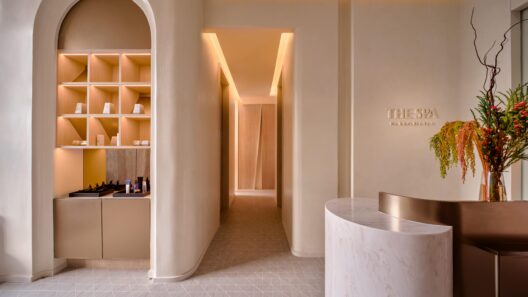
Down below the villas, the Ayung cuts through the landscape, and the resort’s riverside spa turns that natural environment into an entirely different experience.
This is where Hanging Gardens moves beyond being a beautiful hotel.
Water has a particular significance in Balinese culture, and the spa incorporates Balinese ideas around purification, ritual and tirta, or holy water. Treatments, yoga, meditation and wellness experiences are tied to the setting rather than simply taking place inside a conventional spa building.
It feels appropriate.
Up at the hotel, water is suspended above the forest.
Down at the spa, it is moving through it.
The two experiences are connected.
And then there is food
The dining here is becoming more interesting because the resort increasingly looks inward for inspiration rather than simply reproducing the international luxury-resort menu.
Rasa Masa is particularly worth watching.
The concept explores Indonesian cuisine through a contemporary approach, drawing on the country’s enormous culinary diversity rather than reducing “Indonesian food” to a handful of familiar Bali dishes.
That is exactly the direction luxury dining in Indonesia should be taking.
Indonesia is not one cuisine.
It is an archipelago of thousands of islands, cultures, ingredients and traditions.
A resort in Bali has an opportunity to tell that story.
At Hanging Gardens, the setting helps enormously. Eating Indonesian food while looking into one of the country’s great tropical landscapes feels considerably more meaningful than another international restaurant with an Asian-inspired menu.
There are also more relaxed dining options and private experiences, including meals arranged around the villas and the resort’s spectacular surroundings.
The best table, however, may still be whichever one makes you look up from your plate.
Hanging Gardens has aged, and that is not necessarily bad
Here is something rarely mentioned in hotel marketing.
Hanging Gardens is old.
Not old in the grand-hotel sense. But in Bali’s extremely competitive luxury market, twenty years is a long time.
Since 2005, an entire generation of spectacular resorts has appeared across the island. Contemporary hotels now have enormous villas, dramatic architecture, extraordinary restaurants and technology that would have seemed futuristic when Hanging Gardens opened.
And yet the original idea still works.
In fact, its age may be part of its charm.
Hanging Gardens does not look as though it was designed yesterday by a committee studying what is currently fashionable on Pinterest.
It has a personality.
There is a sense that the architecture was developed around this particular hillside and this particular valley, rather than selecting a generic luxury-resort formula and dropping it into Bali.
That distinction becomes more valuable as hotels around the world begin to look increasingly alike.
Who should stay here?
Couples who want privacy will understand the appeal immediately.
Honeymooners will probably struggle to find a more naturally romantic setting in Ubud.
Photographers will have a field day, particularly around dawn and after rain.
Wellness travellers will appreciate the riverside setting and the opportunity to combine a luxury stay with yoga, meditation and spa experiences.
And anyone who has spent too much time fighting Bali traffic may discover that the most valuable hotel amenity is simply being somewhere else.
Families can also make sense here, particularly in the larger accommodation, although the resort’s personality is undeniably more seductive for couples.
Who might not love it?
If you want to walk from your hotel into Ubud’s restaurant scene, this is not for you. If you want a beach, you are several landscapes away from the answer. And if your definition of luxury is a huge resort with endless facilities, Hanging Gardens may initially feel almost restrained.
But that last point is precisely why it works. This is not a resort designed to keep you busy. It is designed to make you forget that you were busy.
The verdict: still one of Bali’s great hotel ideas
There are hotels that become famous because they have a beautiful view.
There are hotels that become famous because they have a famous swimming pool.
And then there are hotels where the architecture, landscape and experience become so intertwined that separating one from another becomes almost impossible.
Hanging Gardens belongs in the third category.
The infinity pool is famous, but it is not really the story.
The story is the valley.
The story is waking up surrounded by rainforest.
The story is having your own warm pool suspended above the Ayung River.
The story is descending into the jungle for a treatment beside the water and then climbing back into a world where the forest seems to stretch endlessly in every direction.
Most importantly, the story is that this idea still works.
Bali has changed enormously since Hanging Gardens opened. Ubud has changed. Luxury hospitality has changed. Travellers have changed.
The jungle has not.
And perhaps that is why Hanging Gardens remains so compelling.
It does not ask you to admire a hotel.
It asks you to disappear into a landscape.
For a few days, that can be the more luxurious thing.
Luxora verdict: 9.5/10
Best for: honeymooners, couples, private escapes, photography, wellness and travellers seeking a deeply immersive Ubud experience.
The reason to book: not simply for the famous infinity pool, but for the rare feeling of having the rainforest entirely to yourself.
The caveat: the secluded location means you trade walkability and easy access to central Ubud for something much harder to find: genuine silence.