
There are grand hotels that you visit because they are famous, and then there are grand hotels that have become part of the city itself. Sofitel Legend Metropole Hanoi belongs firmly to the second category.
Since opening in 1901, the Metropole has occupied an extraordinary position in Hanoi. It has been a hotel, a refuge, a meeting place, a cultural landmark and, perhaps most importantly, a social address. More than 125 years later, it remains one of the most compelling places to stay in the Vietnamese capital. But the real surprise for anyone who has not been recently is that you do not have to check into the Metropole to enjoy it.
Come for dinner. Come for an espresso. Come for afternoon tea. Come for jazz. Come for cocktails and whisky. Come to sit beneath the trees by the pool. Come to watch Hanoi pass by from La Terrasse. Or simply come because, in a city changing as quickly as Hanoi, there is something reassuring about spending an hour somewhere that has seen almost everything.
That is the Metropole’s enduring trick. It has preserved its sense of occasion without becoming a museum.
A hotel with genuine history, not manufactured heritage
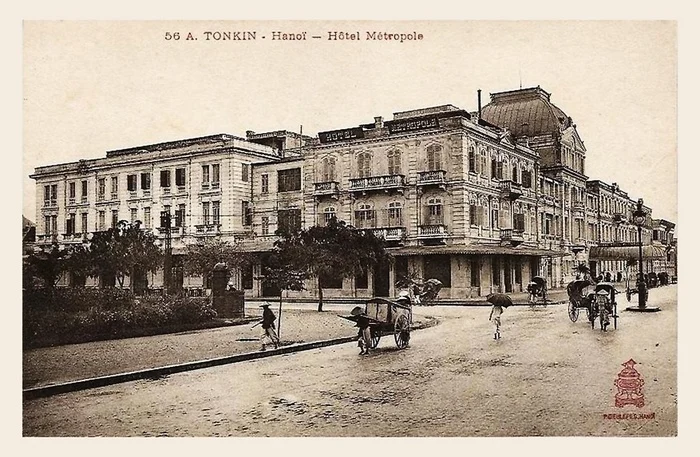
The Metropole opened in 1901, established by French investors Gustave-Émile Dumoutier and André Ducamp. The original hotel became one of Hanoi’s most important meeting places and, according to the hotel’s own historical archive, even hosted some of the city’s earliest cinema screenings.
Its guest list subsequently became the stuff of literary and cinematic legend. Charlie Chaplin honeymooned here with Paulette Goddard in 1936. Somerset Maugham and Graham Greene stayed at the hotel, with Greene’s connection to Hanoi becoming particularly famous through The Quiet American. Three of the hotel’s most celebrated suites now bear the names of Greene, Maugham and Chaplin.
But the history becomes considerably more serious during the war years. The hotel served as a refuge during air raids, and a wartime bunker beneath the property was rediscovered during renovations in 2011. The restored bomb shelter, reopened in 2012, is now part of the hotel’s Path of History experience. The shelter was used by guests including Joan Baez and Jane Fonda during the conflict.
This is what makes the Metropole different from a hotel that has simply adopted an old-fashioned aesthetic. The history is physical. It is underneath the hotel, in its architecture, in its archives and in the stories attached to individual rooms.
In 2026, the hotel is celebrating its 125th anniversary with a year-long programme spanning heritage, culture, gastronomy and entertainment, making the anniversary more than a marketing milestone. It is an opportunity to look at the Metropole as what it has become: part hotel, part Hanoi institution.
And then there is the hotel itself
The accommodation is divided between two very different personalities.
The Heritage Wing occupies the original 1901 structure and was extensively restored, reopening in late 2023 after a 21-month refurbishment. Its interiors retain the character of French colonial Hanoi while adding contemporary comfort, with restored or renewed wooden floors, Italian marble bathrooms, hand-tufted carpets and bespoke furnishings.
The Opera Wing, by contrast, brings a more contemporary neoclassical interpretation of the Metropole. Together, the two wings currently contain 358 rooms and suites.
For travellers choosing a room, that distinction is worth understanding. The Heritage Wing is where the sense of history is strongest. The Opera Wing offers a more contemporary interpretation of Metropole luxury. Neither is necessarily “better”; they simply deliver different versions of the experience.
And for those who want the full literary mythology, the three Legendary Suites are the obvious trophies: Graham Greene, Somerset Maugham and Charlie Chaplin. The Graham Greene connection is particularly evocative for anyone fascinated by the relationship between Hanoi and The Quiet American.
The hotel has also received a MICHELIN Key, with the MICHELIN Guide describing it as a particularly special stay and praising the way its original character has been preserved while being subtly modernised.
That distinction matters. The Metropole is not competing with Hanoi’s newest glass towers on the basis of being newer, bigger or more technologically spectacular. Its appeal is almost the opposite. It offers something that cannot be newly constructed: continuity.
The best reason to visit may be that you are not staying there
This is where the Metropole becomes particularly interesting.
A luxury hotel can sometimes feel like an island, separated from the city around it. The Metropole does not. Its restaurants and bars have long functioned as social destinations in their own right, attracting not only hotel guests but Hanoi’s business community, expatriates, travellers and residents looking for somewhere polished to meet.
That tradition goes back to the hotel’s earliest years, when the Grand Métropole was already described as one of the city’s popular gathering places. More than a century later, the idea still works.
The hotel has essentially created its own little circuit of Hanoi experiences.
You can start with coffee at La Terrasse, move into lunch at Le Beaulieu or Spice Garden, return for afternoon tea at Le Club, have a drink at Angelina, and finish beside the pool at Bamboo Bar. It is possible to spend an entire day here without once feeling as though you are simply sitting inside a hotel.
La Terrasse: Hanoi’s elegant front row
If there is one place that best explains why the Metropole works as a local hangout, it is La Terrasse.
Inspired by the classic Parisian sidewalk café, La Terrasse sits directly on the street side of the hotel, giving guests a comfortable front-row seat to Hanoi’s constant movement. The concept is simple and wonderfully old-fashioned: sit outside, order an espresso, watch people go by and allow the city to provide the entertainment.
The menu extends beyond coffee into casual French-style dining, with salads, tartines, artisanal sandwiches and local touches. It opens from early morning through the evening, making it equally appropriate for breakfast, a mid-afternoon coffee or an early evening glass of something cold.
It is also one of the rare luxury-hotel cafés where the street outside is genuinely part of the experience.
You are not looking at an artificial resort landscape. You are looking at Hanoi.
Le Beaulieu: the French institution
For a more serious meal, Le Beaulieu remains one of the hotel’s essential addresses.
The restaurant has operated in its current location since 1901 and has long been associated with French fine dining in Hanoi. Following an extensive refurbishment, it reopened in 2022 with a contemporary interpretation of its historic setting.
This is the kind of restaurant where the surroundings matter almost as much as the menu. The Metropole’s French heritage gives Le Beaulieu a context that a newly opened French restaurant cannot manufacture.
And there is a delicious historical irony to eating French haute cuisine here. The Metropole is not simply recreating the French Indochina era as theatre. It is part of the architectural and cultural fabric that survived it.
For 2026, the hotel is also marking its 125th anniversary through special culinary experiences across its restaurants, adding another layer to an already substantial dining programme.
Spice Garden: Vietnamese cuisine in grand surroundings
If Le Beaulieu represents the French side of the Metropole’s personality, Spice Garden brings the Vietnamese story forward.
The restaurant focuses on Vietnamese cuisine and has become one of the hotel’s established culinary destinations. The emphasis is on celebrating the country’s food heritage while presenting it within the polished setting expected of a luxury hotel.
This is important because the Metropole works best when it is not treated simply as a monument to French colonial architecture. Its strongest contemporary identity comes from the dialogue between French art de vivre and Vietnamese culture.
That duality runs through the property.
Angelina: where the Metropole gets considerably cooler after dark
Then there is Angelina, which is almost a different hotel altogether.
The cocktail bar, whisky lounge and restaurant has a more contemporary, nocturnal personality, built around cocktails, an extensive whisky collection and inventive comfort food designed for sharing. It also has a cigar lounge and is recognised as Hanoi’s first officially recognised Habanos Lounge.
This is where the Metropole makes its strongest argument that heritage luxury does not have to mean sleepy luxury.
Angelina is designed for lingering. A serious whisky, a well-made cocktail, a late dinner, a conversation that stretches longer than planned. The current 125th anniversary programme even includes a cocktail menu built around moments in the hotel’s history, with creations referencing 1901, 1968 and 2026.
For Hanoi’s sophisticated after-work crowd, this is exactly the kind of place a great city hotel should have: somewhere you can go because it is good, rather than because you happen to be staying upstairs.
Le Club: afternoon tea, jazz and old-school glamour
Le Club is another reason the Metropole feels more like a social institution than a conventional hotel restaurant.
Overlooking the courtyard garden and pool, the venue changes character throughout the day. It serves French brasserie-style food and Vietnamese favourites, while afternoon tea and evening jazz add a distinctly more leisurely dimension.
There is something particularly appealing about the rhythm of it.
Hanoi in the morning is energetic. Hanoi at midday is relentless. By late afternoon, the Metropole offers the possibility of slowing down.
Order tea. Sit in the shade. Listen to jazz. Let the city wait.
Bamboo Bar: the poolside escape
Bamboo Bar is perhaps the most relaxed corner of the property.
Tucked beside the swimming pool, it trades the formal elegance of the Heritage Wing for a more casual, colonial-inspired atmosphere. Cocktails, champagne, coffee, tea and light food are served throughout the day.
It is an especially useful reminder that the Metropole is not simply about chandeliers and polished marble.
There is a pool. There is greenery. There is shade. There is a drink in your hand.
And suddenly, despite being in the centre of Hanoi, the city feels several streets away.
Why the Metropole still matters
The luxury-hotel market in Hanoi has changed dramatically. There are now beautiful contemporary properties, impressive rooftop bars and increasingly sophisticated restaurants. A traveller arriving today has far more choice than the traveller who checked into the Metropole decades ago.
Yet the hotel has retained something the newer generation cannot easily reproduce.
It has memory.
You can walk through the Heritage Wing and see the physical continuity of the place. You can drink a cocktail in a bar that references the hotel’s wartime history. You can sit at La Terrasse and watch modern Hanoi unfold in front of a building that has been standing there since 1901. You can have dinner in a restaurant whose history reaches back to the earliest years of the hotel. You can descend into a wartime bunker and then return upstairs for a glass of champagne.
Few hotels can compress that much history into a single afternoon.
And that is why the Sofitel Legend Metropole Hanoi remains one of the city’s best places to stay.
Not because it is frozen in the past.
Because it has managed to carry the past with it.
For the traveller, that makes the Metropole more than a hotel. It is a way of experiencing Hanoi from inside one of the city’s most enduring stories. And for locals, it remains something equally valuable: somewhere to meet, eat, drink, drink coffee, celebrate, conduct business, listen to music or simply sit and watch the city move.
That may ultimately be the greatest luxury of all.
The Metropole still feels like it belongs to Hanoi.
And after 125 years, that is a remarkable achievement.