

There are parts of Bangkok that announce themselves loudly. Yaowarat glows beneath neon signs, Sukhumvit hums with traffic and rooftop bars compete for the best skyline view.
Then there is Song Wat.
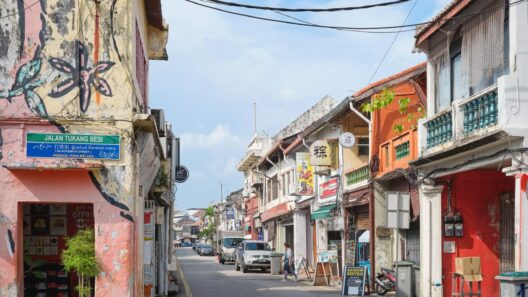
Running for roughly 1.2 kilometres along the Chao Phraya River, Song Wat Road feels quieter, more intimate and considerably more textured. Old Chinese shophouses sit beside contemporary cafés. Traditional trading businesses continue to operate behind weathered façades, while young designers, artists, coffee roasters and restaurateurs have moved into spaces that once belonged to merchants and warehouses.
It is this collision of old and new that has made Song Wat one of Bangkok’s most compelling neighbourhoods to explore.
In 2023, Time Out placed Song Wat at number 39 on its list of the world’s 40 coolest neighbourhoods, selected through surveys of city dwellers and the opinions of local editors and experts. The recognition highlighted exactly what makes the area special: community, culture, food, walkability and the meeting of established local businesses with a new generation of entrepreneurs.
But Song Wat is not simply Bangkok’s latest hipster district.
Its appeal is deeper than that.
A road drawn by a king
The story of Song Wat begins long before the coffee shops arrived.
The road was developed during the reign of King Chulalongkorn, Rama V, following a major fire in the Sampheng area. Construction began in 1892, with the road eventually extending towards Charoen Krung. According to the long-standing story behind its name, the king himself drew the route on a map, giving Song Wat its evocative name, which can be translated as “drawing by the king”.
Its position beside the Chao Phraya made Song Wat an important commercial artery. Goods moved through its warehouses and piers, with seafood, vegetables, spices and other products arriving by river before being distributed throughout Bangkok.
That trading heritage is still visible.
Look closely at the buildings and you will find faded signs, Chinese architectural details, narrow shophouses and businesses that appear almost untouched by the passage of time.
This is one of the reasons walking is so much more rewarding here than simply arriving at a particular café.
Song Wat is best experienced as a sequence of details.
Where old Bangkok meets the new Bangkok
Over the past several years, Song Wat has undergone a remarkable transformation.
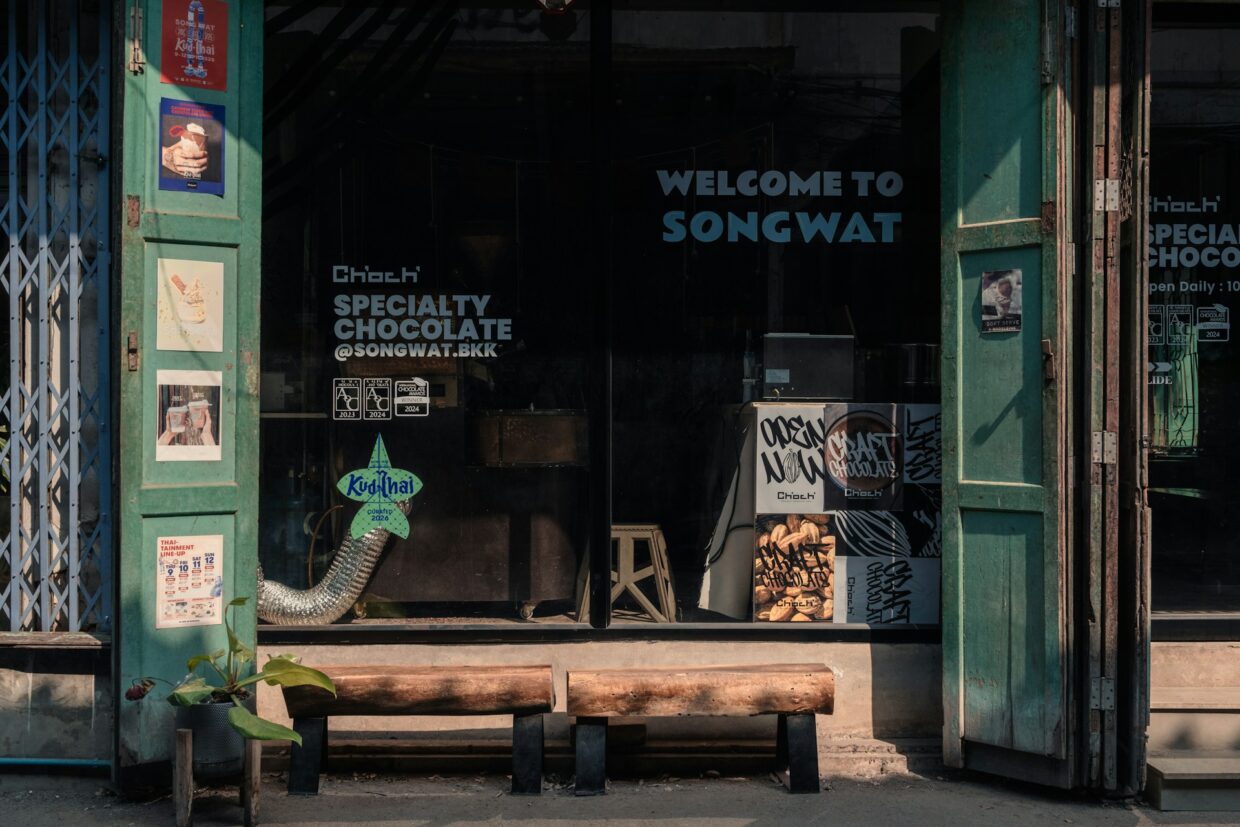
Some old buildings have been restored. Others have been given new life as coffee shops, restaurants, galleries, boutiques and creative spaces. Street art has become part of the neighbourhood’s visual identity, while younger businesses have brought a distinctly contemporary energy to streets that were once primarily associated with trade.
Time Out describes the area as a creative makeover that has retained its historical character, with shopkeepers and artists effectively turning parts of the neighbourhood into an outdoor gallery.
That balance is the real attraction.
You can photograph a beautifully restored shophouse, walk past a decades old trading business and then sit down for a carefully prepared specialty coffee without ever leaving the same street.
It feels distinctly Bangkok.
And importantly, it does not feel manufactured in the way some newly created lifestyle districts can.
What to see on Song Wat Road
Follow the street art
You do not need an itinerary to appreciate Song Wat’s murals.
They appear unexpectedly on walls, shutters and building façades, creating an informal outdoor gallery that rewards slow exploration. Song Wat Street Art is one of the easiest landmarks to use as a starting point.
The best approach is not to arrive with a checklist. Walk slowly, look into the side lanes and keep your camera away from your face occasionally.
Some of the most interesting details are architectural rather than artistic.
Look inside the shophouses
Song Wat’s old commercial buildings are part of the experience.
Many retain their original proportions, narrow façades and decorative details. Some have been beautifully restored, while others remain wonderfully imperfect.
That contrast is what makes the neighbourhood photogenic.
It also explains why Song Wat appeals so strongly to photographers and design conscious travellers.
Visit the shrines and religious landmarks
The neighbourhood’s history is multicultural rather than exclusively Chinese.
The Lao Pun Tao Kong Joss House represents the area’s Chinese heritage, while Masjid Luang Kocha Itsahak reflects its Muslim community. Wat Pathum Khongkha provides another layer of Bangkok’s religious and architectural history.
Rather than treating these as isolated tourist attractions, they make more sense as part of the wider story of Song Wat as a trading community where different cultures met.
Where to stop for coffee
Coffee has become one of Song Wat’s defining new attractions, and there is now enough choice to justify a dedicated café crawl.
For a first visit, LOCAL BOYS COFFEE CO. SONG WAT is one of the strongest recommendations.
It currently carries a 4.8 rating from more than 2,200 Google reviews, and it has also developed a strong reputation among Bangkok’s coffee community. One frequently mentioned favourite is its coconut dirty coffee.
For something quieter and more understated, Terroir.BKK SONGWAT is another worthwhile stop. Its setting inside the historic streetscape makes the coffee experience feel particularly connected to the neighbourhood.
SCR – Song Wat Coffee Roasters is another established option, with hundreds of reviews and a focus on coffee rather than simply the aesthetics of the space.
And for a more casual neighbourhood café, Lost in songwat has attracted a strong local and visitor following.
One thing to remember: Song Wat is not necessarily a destination for spending an entire afternoon in air conditioned cafés. The charm comes from moving between them.
One coffee. Then walk.
Then another.
Then lunch.
Where to eat
The food scene is where Song Wat becomes particularly interesting.
There are modern restaurants and stylish new openings, but some of the area’s most memorable food comes from businesses that existed long before the neighbourhood became fashionable.
Braised goose is one of the local classics worth seeking out. Urai Braised Goose is frequently recommended in guides to the neighbourhood and has been recognised with a Michelin Bib Gourmand. It is also known for selling out early, so arriving around lunchtime rather than late afternoon is sensible.
For something more contemporary, Padthai Bar (Song Wat) offers a more polished take on one of Thailand’s best known dishes.
The neighbourhood also has plenty of smaller food stops and traditional noodle shops. This is where Song Wat differs from a conventional restaurant district: you are not necessarily looking for one spectacular meal.
You are grazing.
A noodle dish here.
A snack there.
A coffee.
Something sweet.
Then perhaps a drink beside the river.
That is the better way to eat your way through Song Wat.
Do not leave without dessert
One of the more unusual newer additions is AGAR RAGA – อาการากา | The First AGAR Cafe คาเฟ่แรกที่ทุกจานทำจากวุ้น, where agar jelly is the central ingredient.
For something more conventionally indulgent, Arteasia Desserts & Cafe (2nd Floor) has become another popular stop, with a particularly strong online following.
The point is not to find the single “best” café or dessert shop.
Song Wat is better understood as a neighbourhood to sample.
The Song Wat review: what visitors really think
The online response to Song Wat is overwhelmingly positive, but it is more nuanced than the usual “hidden gem” travel story.
Visitors repeatedly praise the atmosphere, street art, architecture, cafés and the feeling of discovering somewhere different from Bangkok’s conventional tourist circuit.
Recent travellers on Reddit have noted how dramatically the area has changed over the past few years, with new cafés, restaurants, bars and shops appearing at a rapid pace. Some visitors describe it as a place they would happily revisit, particularly on weekdays.
There is, however, another side to those reviews.
Some long time visitors worry that Song Wat is becoming too commercialised. Traditional businesses are being replaced or pushed aside as rents and visitor numbers increase, while some recent visitors describe weekends as crowded with photographers, influencers and queues.
That criticism is worth taking seriously.
Song Wat’s charm comes from the fact that it is still a functioning neighbourhood rather than a theme park designed around visitors.
The best way to experience it is therefore also the simplest: spend money with local businesses, respect residents, avoid blocking narrow streets for photographs and explore beyond the most Instagrammed corners.
When should you visit Song Wat?
For most travellers, weekday mornings are ideal.
The light is good for photography, the streets are calmer and you have a better chance of experiencing the neighbourhood as a working commercial district rather than a weekend lifestyle destination.
Saturday and Sunday can be considerably busier. Recent visitors have described weekends as crowded, with queues and photography groups becoming increasingly common.
If you want the cafés and creative scene, arrive around 9:00 or 10:00am.
If food is the priority, going earlier is sensible because some traditional vendors can sell out around lunchtime.
For photography, late afternoon can be beautiful, particularly when the light begins to soften over the old shophouses.
How to get to Song Wat Road
The easiest public transport option is the MRT.
Take the Blue Line to Wat Mangkon Station, then use Exit 1 and walk through the Chinatown streets towards Song Wat. Time Out recommends this as one of the simplest ways to reach the neighbourhood.
Another atmospheric option is to take a boat along the Chao Phraya to Ratchawong Pier. From there, Song Wat Road is only a short walk away.
For visitors already exploring Chinatown, the transition is effortless.
Walk from Yaowarat towards Song Wat and you will quickly notice the change.
The crowds thin.
The neon fades.
The streets become quieter.
The architecture becomes older.
And Bangkok suddenly feels much more intimate.
The perfect Song Wat half day
If you have half a day to spare, this is how we would do it.
10:00am
Arrive at Wat Mangkon and walk towards Song Wat through the old Chinatown streets.
10:30am
Explore the murals, shophouses and small lanes. Stop wherever something catches your eye rather than following a rigid sightseeing route.
11:00am
Coffee at LOCAL BOYS COFFEE CO. SONG WAT or Terroir.BKK SONGWAT.
12:00pm
Have lunch at one of the neighbourhood’s traditional food businesses. Urai Braised Goose is particularly worth considering, but arrive early if you want to avoid disappointment.
1:00pm
Continue towards the river, exploring the smaller lanes and historic buildings.
2:00pm
Stop for dessert or another coffee at one of the newer cafés.
3:00pm
Continue south towards Talat Noi.
This is where Song Wat becomes part of a much larger walking experience. The two neighbourhoods connect naturally, and combining them creates a much richer half day than treating Song Wat as a single street.
Is Song Wat worth visiting?
Absolutely.
But not because it is Bangkok’s latest trendy neighbourhood.
Visit because it gives you a glimpse of a Bangkok that is still evolving.
The old warehouses and Chinese shophouses tell the story of a commercial city built around the river. The new cafés, restaurants and creative businesses tell another story about a younger generation rediscovering those same streets.
The tension between the two is precisely what makes Song Wat compelling.
And perhaps that is why the neighbourhood’s international recognition feels deserved. Time Out’s 2023 ranking was based not simply on restaurants or Instagram appeal, but on a combination of food, culture, community, walkability and the ability of a neighbourhood to retain its identity while changing. Song Wat came in at number 39 globally.
For now, the best time to see it may be before the transformation is complete.
Because Song Wat is not really a finished destination.
It is a neighbourhood in the middle of becoming something new, while still carrying the memory of what it has always been.
And that is what makes a walk down Song Wat Road feel so distinctly Bangkok.